March 24th, 2015 by iisg_superadmin
Scientists at the University of Illinois at Chicago have unearthed a species of Lake Michigan bacteria that may become a powerful weapon in the fight against tuberculosis. Found in the sediment off the coast of Milwaukee, the microbe’s medicinal power lies in the small compounds it makes to defend itself.
UIC researcher Brian Murphy and colleagues at the College of Pharmacy are still trying to pin down how the molecules attack the M. tuberculosis bacterium, but they know that the compounds display drug-like potency against a range of antimicrobial-resistant strains that rivals existing clinical treatments.
This study is part of a larger effort by Murphy and others to determine the disease-fighting potential of aquatic actinomycete bacteria. Current treatments for many diseases are built around the chemical defenses used by land-based bacteria, but a growing number of pathogens are now resistant to standard drugs. Results like these in Lake Michigan suggest that freshwater bacteria may create molecules that dangerous pathogens have yet to evolve defenses against, making the Great Lakes a potentially untapped reservoir of treatments for some of the world’s deadliest diseases.
To understand the potential of the lakes, Murphy has collected more than 600 strains of freshwater actinomycete bacteria with support from an IISG Discovery Grant. The size and diversity of the library will help reveal both whether these bacteria are significantly different than their land-based cousins and if strains found in different lakes produce unique chemical defenses.
This analysis is still underway, but Murphy and his team have already discovered that the makeup of actinomycete communities in Lake Huron varies both by location and depth, a diversity that makes the lake a potentially important site in the hunt for new cures.
March 19th, 2015 by iisg_superadmin
Allison Neubauer and Kirsten Walker were at the University of Illinois Public Engagement Symposium last week to raise awareness of IISG outreach in Champaign-Urbana. Allison had this to say about the event.
The public engagement symposium was a great opportunity to find out what other local organizations and academic programs are working on. The crowds of people—both those staffing booths and walking through and exploring—were a true testament to Champaign-Urbana’s widespread effort to get involved and take collective action on local initiatives.
Our IISG table generated a lot of traffic. With spring on the horizon, many visitors were excited to learn about our mobile walking tour of downtown Chicago. Others stopped to discuss invasive species and ways they can help halt their spread.
 But the biggest draw was our university Learning in Community (LINC) course poster, created by undergraduate students enrolled in our section last fall. These students focused on increasing awareness on campus about how pharmaceuticals contaminate our waterways. They also coordinated a take-back event for students and community members to properly dispose of their unwanted medication. The event was a big success, collecting 15 pounds of unused medicine for incineration in just six hours.
For Kirsten and I, what was particularly exciting and unique about this symposium was our ability to connect with others working locally on related problems. For example, a Champaign community health center invited us to discuss pharmaceutical disposal with their patients. There was also a UIUC engineering student interested in the homemade filtration system our LINC students created with local high schoolers to show how some contaminants can slip through wastewater treatment processes. She is currently working to design and implement a water system and health program in a rural Honduran community and was looking for ways to engage with local residents.
March 18th, 2015 by iisg_superadmin
Where we take a moment to explore some of the unique and impressive species that call the Great Lakes home.
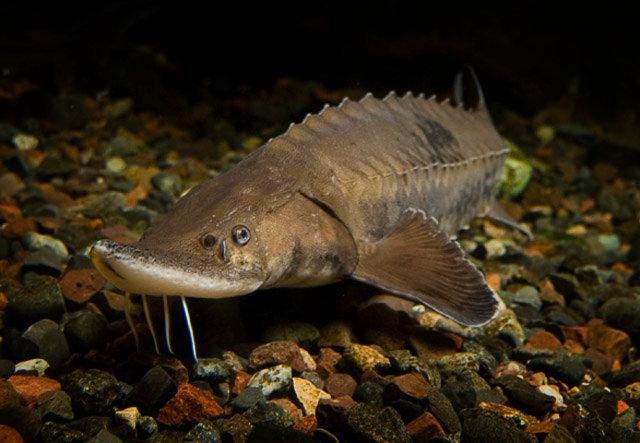 Skin like a shark, feeding habits akin to those of a whale, and a lifespan comparable to our own—the lake sturgeon is a peculiar species indeed. Found in large lakes and rivers, this toothless, whiskered bottom feeder is the largest, longest living, and one of the most ancient species in the Great Lakes. With an average length of 3-5 feet and a weight of 10-80 pounds, some lake sturgeon have grown to be 8 feet long and 300 pounds. Males typically live around 50 years while females’ lifespans range anywhere between 80-150. And with origins during the late cretaceous period, this species has remained relatively unchanged since the time of the triceratops and the tyrannosaurus rex.
The lake sturgeon’s skeleton is partly cartilaginous. Its body has no scales and is lined with five rows of bony plates called skutes—one on top and two rows along each side. Two pairs of fleshy sensory organs called barbels hang from its shovel-like snout like whiskers to help the lake sturgeon find prey. Its diet consists primarily of benthic organisms—small bottom-dwelling creatures like mussels, snails, crustaceans, aquatic insects—but they have been known to eat small fish. With no teeth, the lake sturgeon uses its snout to dig up whatever prey it finds and then sucks it up through its protractile mouth, filtering out sediment through its gills while digesting the organic material.
As hardy as the lake sturgeon may seem, its population suffered almost incalculable losses in the late 19th century. Initially thought of as a nuisance fish that damaged fishing equipment, lake sturgeon were slaughtered en masse. They’d be buried on shore or lined up to dry in the sun like stacks of timber and later used as fuel for steam ships due to the high oil content of their meat. Over time, lake sturgeon meat and eggs became prized commodities, leading to overfishing and an eventual collapse in population.
Recovery has historically been a challenge due to the lake sturgeon’s naturally slow reproductive cycle, with males only reaching maturity around 15 years of age and females at closer to 20. This in combination with lake and river pollution, habitat loss, and dam activity blocking access to spawning grounds has lead to a long decline of lake sturgeon populations across the U.S. and Canada. As a result, lake sturgeon are listed as an endangered, threatened, or species of special concern by 19 of the 20 states where they are found.
But in recent years, some populations have started to rebound. State and Canadian governments now enforce strict policies that limit the number of sturgeon caught each year. Spawning habitats have been constructed, watersheds have been stocked, and eggs have been raised in artificial cultures. People are also encouraged to report any sightings of lake sturgeon to help get a better idea of their numbers.
***Photo by Great Lakes Aquarium
March 16th, 2015 by iisg_superadmin
Household leaks cost the country more than a trillion gallons of water a year—enough to quench the water needs of roughly 11 million homes. The common culprits are toilet flappers, dripping faucets, and other leaky valves. Fortunately, there are easy steps you can take in your home and yard to save water and money. And that’s what Fix a Leak Week, March 16-22, is all about.
Sponsored by EPA’s WaterSense program, Fix a Leak Week offers demonstration events and online resources to help homeowners find and fix leaky toilets, shower heads, and more.
Household Water Efficiency is part of a larger effort to help individuals and communities secure a sustainable water supply. The Chicago region has long benefited from an abundance of fresh water. But legal limits on how much can be pulled from Lake Michigan and strained aquifers have left many concerned that demand will outpace supply.
In response to these concerns, CMAP led the development of a comprehensive water supply management plan for the 11 counties in the greater Chicago area. IISG research, including an overview of water rates, provided critical data for key components of the plan. IISG also developed a guide that helps city officials plan and implement water rates that encourage conservation and provide sufficient funding for utilities to detect and fix leaks in their water systems.
March 11th, 2015 by iisg_superadmin
Earlier this year, AP science students at Chicago’s Lane Tech College Prep traded in their textbooks for field equipment to study water quality in the North Branch of the Chicago River. The Hydrolab allows students to monitor water characteristics like dissolved oxygen, pH, and conductivity with sensors similar to those used by scientists at the EPA Great Lakes National Program Office. The teacher, Dianne Lebryk, borrowed the equipment through the Limno Loan program to help students better understand the connection between water quality and man-made landscapes.
Several students wrote in to share their experiences working with the Hydrolab. We wrap things up today with Gayin Au.
Under the circumstances of an extremely frosty cold weather, our environmental classmates were still very eager to head out and experience the Hydrolab. As soon as we reached the river by our school, we saw a lot of trash in the river. The water looked very dense and had a very dark green color.
Two people were responsible for holding the Hydrolab since it was quite heavy. The others stood back to watch. I was surprised that we were able to get results really quick; at first I thought it would take a lot of time to process the information.
Goose poop, which is high in nitrate, dissolves and mixes into the water and plants use this nitrogen to keep them nice and fertilized. However, the river is also greatly harming the living things in it. The water lacked oxygen, meaning it will be more difficult for living things in there to survive. It also might mean there aren’t enough plants underwater to keep the normal level of oxygen up. It was greatly contaminated, and fish and other organisms will be affected, making them act unusually.
The lab was really quick and useful. It showed us the oxygen level, how much algae is in there, how polluted the river is in general, and more. The river goes by so many things that can affect it. Human trash, fertilizer, and goose poop (common near our school thanks to large fields of grass) all affect the quality of water.
March 9th, 2015 by iisg_superadmin
 Community medicine collection programs make it easy for people to rid their homes of unwanted pharmaceuticals, but they can be difficult to get off the ground. That’s where our Unwanted Meds team comes in. They have helped police departments across Illinois and Indiana establish collection programs and raise awareness of the importance of proper disposal.
From Rx for Action:
In today’s Community Spotlight feature, we look at West Lafayette Police Department’s Prescription/Over-the-Counter Drug Take Back (Rx/OTC) program. In 2010, Officer Janet Winslow started the wildly successful take-back program, one that has no doubt had a dramatic impact on the community and the environment.
Officer Winslow took a little time out of her busy schedule to answer a few questions for us about the take-back program. And if the work she does here isn’t enough to show what an asset to the community she is, she has also just been named a YWCA Greater Lafayette Woman of Distinction, and will be honored at the “Salute to Women” banquet. Congratulations Officer Winslow!
1. The West Lafayette Police Department collection program started in March 2010. How did this program come about for your area, and why did you decide to take part?
DARE America sent out a request for DARE officers to provide the community with a presentation on Rx/OTC medicines and do a take-back at the same time. I did a community presentation and actually had more people bring me Rx/OTC to be destroyed then that came to the presentation. Since that was successful I asked my Chief if I could try to do it monthly to see how the turnout would be. The “go greener” commission had also expressed and interest to the city government to attempt a take-back.
2. What has been the community’s response? What are people saying about the medicine take-back opportunities and the program?
I do the take-back monthly and every month I think it will be less. I literally have people standing in the police department lobby waiting for me to get my table and boxes set up. It has grown from one small box (~25 pounds) to 6-12 boxes, sometimes over 200 pounds every month. A lot of the people who use my program thank me for providing it to the community.
3. A lot of take-back programs have permanent collection boxes at police departments, but you plan, set-up, collect, and run the entire program (monthly events) yourself. What are some benefits of running a program in this manner?
My chief has asked me several times about getting the permanent box. My answer is always the same: I do not have time daily to check the box. I do not want liquids spilled in the box or broken bottles. Due to a lack of space I started separating the pills from the bottles. I do this as I am taking them back. I then recycle the bottles and the lids are delivered to an organization that makes park benches. I also like the interaction I have with the community during the take-backs.
March 4th, 2015 by iisg_superadmin
A closer look at web tools and sites that boost research and empower Great Lakes communities to secure a healthy environment and economy.
Even in the gloomy winter months, the beauty of southern Lake Michigan’s natural and urban landscapes is undeniable. But you don’t have to take our word for it. Our photo bank is chock full of stunning images of some of the area’s most celebrated sites—Illinois Beach, downtown Chicago, the Indiana Dunes, and more.
To see the full range of galleries, visit iisg.photoshelter.com or click on ‘Photos’ on our homepage.
If you see one you’d like to include in your own print or online resources, click on ‘Contact’ at the top of the page and send us a request.
March 3rd, 2015 by iisg_superadmin
Stormwater management in Indiana is getting a shot in the arm next month with the launch of the Rainscaping Education Program.
 A collaboration between Purdue Extension, IISG, and others, the program provides how-to information and resources on landscape design and management practices that help prevent polluted stormwater from reaching local waterways. Practices are appropriate for both residential gardens and small-scale public spaces, including schools and community centers.
It all starts April 14 with the first in a series of workshops focused on rain gardens. Over the course of five three-hour sessions, participants will visit and discuss existing rain gardens in the community and learn how to design, construct, and maintain one with a focus on community education. They will also get a chance to test their knowledge by collaborating on a demonstration rain garden with community partners.
The Rainscaping Education Program is open to Purdue Master Gardeners, personnel at conservation organizations, stormwater professionals, and landscape professionals and consultants. For more information and to learn how to register, visit the program website.
***Photo: The plants and soil in rain gardens help absorb stormwater and filter out pollutants. Courtesy of the Champaign-Urbana Residents for Raingardens and BioSwales.
February 18th, 2015 by iisg_superadmin
A closer look at web tools and sites that boost research and empower Great Lakes communities to secure a healthy environment and economy.
With flu season waning and allergy season on its way, it’s important to keep in mind how to properly dispose of unused and unwanted medicine. IISG’s Unwanted Meds website explains the dangers of flushing or throwing away pharmaceuticals and personal care products (PPCPs) and provides information, tools, and resources to help individuals, communities, and educators protect aquatic ecosystems.
 The award-winning site contains information on collection programs and events for the Great Lakes region and beyond, as well as a list of commonly accepted and unaccepted items. Instructions for alternative disposal methods are also included for individuals without access to collection programs.
And visitors looking to prevent PPCP waste will find tips and resources for reducing the amount of unwanted medicine in their homes as well as avoiding personal care products with potentially harmful chemicals.
Local decision makers can take advantage of a free toolkit with instructions for how to safely and legally conduct their own collection program or event. And educators can get help incorporating pollution prevention into their teaching with resources like The Medicine Chest and The Prescription Pill and Drug Disposal (P2D2) Program.
In addition to tips and tools, Unwanted Meds is also host to the latest information on the science behind PPCPs. Its Rx for Action blog discusses leading research on everything from where pharmaceuticals have been detected to how these chemicals impact wildlife to new technologies for removal during wastewater treatment. Readers can also go behind the scenes with the scientists working to make sense of this complicated topic with the UpClose interview series.
For the last information on PPCPs and other emerging contaminants, be sure to follow our pollution prevention team on Twitter, Facebook, Youtube, or Google+.