November 6th, 2012 by Irene Miles
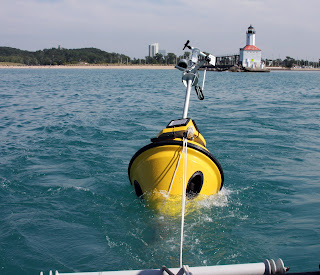
.JPG) The research buoy launched off the coast of Michigan City, IN earlier this fall has been brought inland for winter, but will return to the water next spring for its first full season monitoring environmental conditions in Lake Michigan’s nearshore waters.
The research buoy launched off the coast of Michigan City, IN earlier this fall has been brought inland for winter, but will return to the water next spring for its first full season monitoring environmental conditions in Lake Michigan’s nearshore waters.
It has been less than two months since the buoy began feeding real-time data to the IISG website. In that short time, though, the data has been used by scientists, anglers, and boaters alike to better predict weather conditions, target where to fish, and identify the safest times to be out on the lake. Many of these users have reached out to IISG with feedback on the buoy and the website.
“We have heard from so many different groups of people, from recreational paddlers to research scientists, and the response has been overwhelmingly positive,” said Carolyn Foley, IISG assistant research coordinator. “People are grateful to have data for an area that was previously not being monitored.”
More than 500 people have visited the website since it went live in early September to see real-time snapshots of lake conditions or to examine trends shown over 24-hour and 5-day periods. IISG staff members have heard from sailors, kayakers, anglers, and local residents who say they plan to regularly use the information collected on wave height, water temperatures, and wind speed before venturing from shore. Sailors from Indianapolis told IISG that the up-to-date information on lake conditions will help them more safely make their seasonal trip from St. Joseph, MI to Michigan City. The same data will also be used by fisheries researchers at the Purdue University West Lafayette campus to determine when to make the two-hour drive up to the lake for sampling trips.
The collected data has also been used by researchers to improve models used to predict weather and current changes. For example, the National Weather Service (NWS) office in Northern Indiana was able to adjust its forecast for wave heights by several feet in mid-October based on the real-time data from the buoy. Engineers from other federal agencies have also requested data to use in models designed to examine the movement of water and heat in lower Lake Michigan.
The buoy’s launch also attracted regional press coverage that continued well after it was placed in the water. Indiana TV and newspapers were joined by news outlets from Illinois and Michigan—including the Detroit Free Press—in their coverage. The launch was also featured in trade blogs such as the Environmental Monitor and recreational forums like the Great Lakes Angler Forum.
Although real-time data will not be available while the buoy is in winter storage, an archive of the information collected from early September to late October of this year will be released in the coming months. Visit www.iiseagrant.org/buoy for more information.
November 2nd, 2012 by Irene Miles
Lakes Michigan and Huron almost set records for low water levels in October, as the long-term effects of this summer’s drought are still being felt.
From the Detroit Free Press:
“The U.S. Army Corps of Engineers, which tracks Great Lakes ups and downs, recorded Michigan-Huron at 576.6 feet above sea level for October. That’s an inch-and-a-half above the lowest point for that month since the agency began keeping records in 1918, and about 6 inches above the all-time low recorded in March 1964.
Michigan and Huron are considered one lake from a hydrological perspective because they have the same surface level and are connected at their northern ends by the 5-mile-wide Straits of Mackinac.”
Read the complete article at the link above for more information about the lake levels and their causes.
October 31st, 2012 by Irene Miles
A recent study of several Great Lakes has revealed a high concentration of plastic pollution – higher levels than any other water body on the planet, according to the findings.
“The study is the first to look at plastic pollutants in the Great Lakes. It is part of a larger global endeavor to understand the origin and prevalence of plastic pollution in water and was conducted with the Los Angeles-based 5 Gyres Institute.
“We had two samples in Lake Erie that we just kept going back and rechecking the data, because the count, the number of plastic particles in the sample, was three times greater than any sample collected anywhere in the entire world,” SUNY chemistry professor and project lead Sherri Mason said.”
Follow the link above for the complete article, which offers additional information about the types of plastic pollution and the plans for additional study.
October 12th, 2012 by Irene Miles
The U.S. EPA recently awarded a Great Lakes Restoration Initiative grant to the Ozaukee Washington Land Trust to help them in their fight against some of the most common and invasive plant species that have taken hold in Wisconsin wetlands.
“This quest received a financial boost last week when the U.S. Environmental Protection Agency awarded a $448,663 Great Lakes Restoration Initiative grant to the Ozaukee Washington Land Trust. In return, the group and its partners will inventory and eliminate the most aggressive of invasive plants in wetlands and waterways in the six counties.
Graff, executive director of the land trust, said work will continue the rest of this year on locating each infestation. The organization is working with other land trusts in the region, the Wisconsin Land and Water Conservation Association and River Alliance of Wisconsin to curb the threat posed by the exotic plants.”
Follow the link above for the complete article, including information on other groups across seven Great Lakes states that received funds to help fight invasive species.
October 11th, 2012 by Irene Miles
Chicago area waters will be searched again beginning next week for indicators of Asian carp presence near Lake Michigan.
From WTAQ.com:
“Over 170 samples were taken from Chicago’s North Shore Channel from June through September – and 10-percent had the carp’s DNA. The same was true for 17 of 57 samples last month in the nearby Chicago River.
As a result, an actual search for the bloated carp will take place next Tuesday through Friday on the North Shore Channel and a six-mile stretch of the Chicago River west of the city.”
Read the complete article at the link above.
October 3rd, 2012 by Irene Miles
If you tuned in to “Off the Hook: Extreme Catches” this past Sunday on Animal Planet you got a chance to see Asian carp, a major aquatic invasive concern, as well as some people who are fighting the flying fish.
“The Animal Planet show that spent four days filming on and around the Illinois River last summer for a feature on the acrobatic insanity of everyone’s least favorite invasive fish, the Asian carp, will be shown Sunday.
“Off the Hook: Extreme Catches,” with host/professional wrestler Eric Young presents “Carpocalypse Now” at 7 p.m. Sunday. Greg Gephards, who owns Schooners on War Memorial Drive and had a role in the production of the program, is hosting a party for the occasion.”
October 2nd, 2012 by Irene Miles
 Thousands of residents in Illinois and Indiana came out last Saturday with the goal of ridding their homes of unwanted pharmaceuticals as part of the Drug Enforcement Administration’s (DEA) 5th annual National Prescription Drug Take-Back Day. From 10 a.m. to 2 p.m. police officers and volunteers in more than 200 locations in Illinois and 70 in Indiana collected bottles, boxes, and sometimes even garbage bags full of prescription and over-the-counter human and veterinary medications. Everything collected will be properly incinerated by the DEA.
IISG staffers were at two of these locations at Walgreens stores in Champaign and Urbana, joining local police officers and Walgreens representatives to collect medication, answer questions about the environmental effects of throwing away or flushing pharmaceuticals, and provide information on how to safely dispose of medications when collection events are not available.
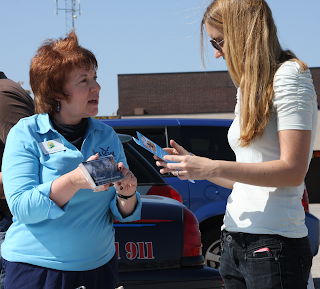
At both locations, people began lining up to hand over their medicine even before the event began. IISG volunteers heard from several people that they had been saving medications in anticipation of Saturday’s event. Take-back event regulars brought medications accumulated just since April’s DEA-sponsored event, but some brought pharmaceuticals with much older time stamps. One woman disposed of medicine she had been storing in her cabinet since 2005, and another brought in medication that was almost 20 years old. Exact figures on how many pounds of pharmaceuticals were collected during the 4-hour event won’t be announced by the DEA for several weeks, but police officers involved in the event described the day as on track to exceed previous take-back events.
Single-day collection events like this are an important way to limit negative impacts to wildlife and local waterways from prescriptions and medications that are improperly disposed of. A wide-range of pharmaceutical chemicals has been found in rivers, groundwater, and drinking water throughout the country due to medications being flushed down the toilet or thrown in the trash. The impact of these chemicals on long-term human health is still unknown, but a connection between pharmaceutical-contaminated waters and impaired development, behavior, and reproduction has been found in many species of fish and other aquatic wildlife.
Ridding homes of unused medication can also help protect the elderly, children, and pets from accidental poisonings and reduce instances of prescription or over-the-counter drug abuse.
IISG has been educating people on pharmaceutical stewardship issues and helping communities establish safe and legal permanent medicine collection programs for more than six years. For additional information on how to dispose of medicine between take-back events or in areas where collections are not available, visit www.unwantedmeds.org.
September 28th, 2012 by Irene Miles
A lot of people might know that Illinois-Indiana Sea Grant’s primary mission is to help protect and preserve the Southern Lake Michigan waters. But most people might not know about the many ways our program goes about doing just that.
With the help of staff members, researchers, educators, and more, we’ve produced a video that offers a glimpse at the program and the ways we work for and with the public to ensure safe waters and healthy ecosystems in both states.
Watch the video below to learn more about Illinois-Indiana Sea Grant, and share it with anyone who cares about keeping Lake Michigan healthy, beautiful, and safe.
September 25th, 2012 by Irene Miles
Runoff from a variety of land uses, including agriculture and industry, has been identified as one of the primary causes of harmful algal blooms (PDF) in the Great Lakes and surrounding waterways. The danger of these algal blooms comes in the form of botulism outbreaks, toxins, and harmful metabolites – all of which can have serious consequences for native plants, fish, and human health.
One potential solution that has been in use in Ohio is the planting of radishes, not only to help manage water and runoff, but also to improve soil quality for agricultural users.
“The radishes planted in northwest Ohio go in about this time of year and are left in the ground to die, explained our host, Allen Dean. Planting doomed radishes, it turns out, is an innovative technique he has used in recent years to improve soil nutrients and reduce runoff from his Williams County farm.
Here’s the basics on how it works: Farmers plant seeds for a plant called an oilseed radish. It doesn’t actually have to be that plant, but it needs to grow a foot or longer into the soil during the fall in a tubular shape, like a carrot or a parsnip. It also needs to grow a fair amount of foliage up on the ground. Radishes are usually more affordable.
It’s important that the plant drill down into the soil so that when it dies, usually during a mid-January freeze, it decays and leaves behind a v-shaped hole for snow and water to penetrate deeper. The decayed radishes Dean showed us looked like organic socks.
Oilseed radishes are particularly good at absorbing nutrients from the surface and sending them down into the soil as the tubular plant drills it way into the ground.”
Read the complete article above to find out more about how these plants are helping farmers and protecting the Great Lakes waters at the same time.

.JPG) The research buoy launched off the coast of Michigan City, IN earlier this fall has been brought inland for winter, but will return to the water next spring for its first full season monitoring environmental conditions in Lake Michigan’s nearshore waters.
The research buoy launched off the coast of Michigan City, IN earlier this fall has been brought inland for winter, but will return to the water next spring for its first full season monitoring environmental conditions in Lake Michigan’s nearshore waters.